Full Bands and Full Torch Dimes: What FB and FT Mean
What FB (Full Bands) and FT (Full Torch) mean on Mercury and Roosevelt dimes, how to check the bands yourself, and how to spot faked Full Bands.
If you’ve looked up a Mercury or Roosevelt dime on a grading company’s price guide, you’ve probably seen the same coin listed twice: once plain, and once with FB or FT after the grade. Those letters stand for Full Bands and Full Torch. They mean the coin was struck sharply enough to show every line in one small part of the design, and on some dates they make a big difference in value.
What Is a “Strike Designation”?
A grade like MS 65 sums up a coin’s condition in one number. For a few series, PCGS and NGC add a note after the grade about how well the coin was struck, meaning how fully the dies pressed the design into the metal. On dimes, that note is FB for Mercury dimes and FT for Roosevelt dimes.
A weak strike isn’t wear. A coin can come straight from the Mint, never touched, and still have mushy details because the dies were worn or the press didn’t hit hard enough. Full Bands and Full Torch tell you the strike was a good one.
Full Bands on Mercury Dimes (1916 to 1945)
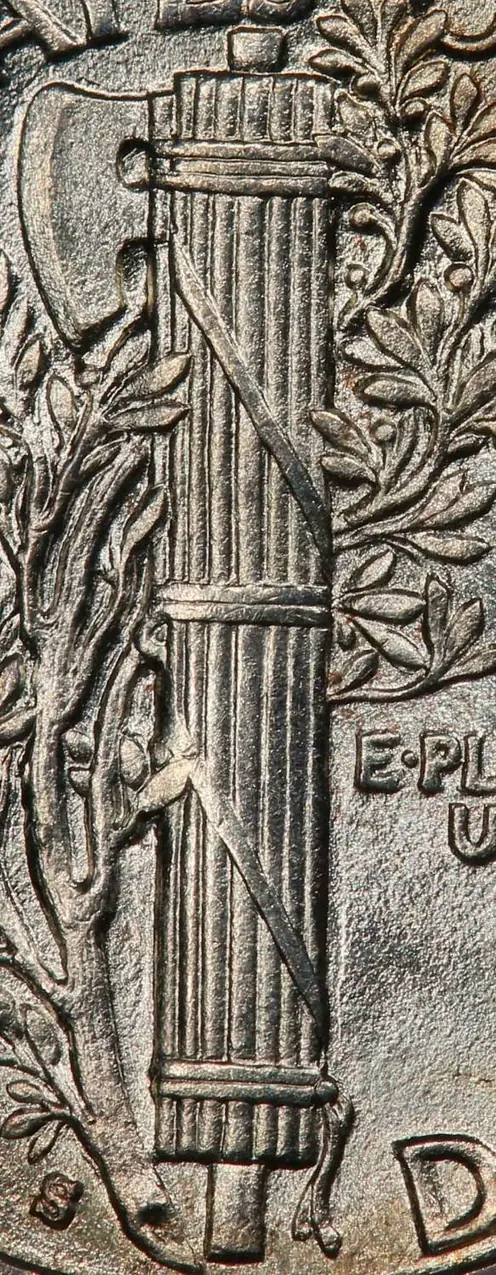
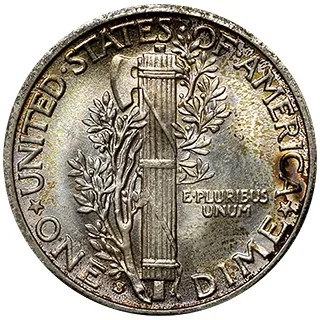
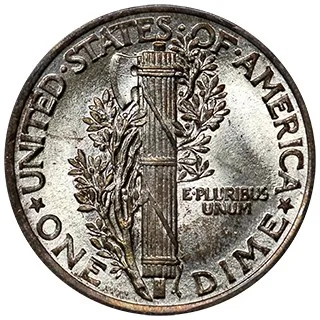
The back of the Mercury dime shows a fasces, a bundle of rods with an axe, tied together by bands at the top, middle, and bottom. Each set of bands is a pair of horizontal lines with a groove between them. On a sharply struck coin, that groove runs all the way across. On a weak strike, the two lines blur together in the middle.
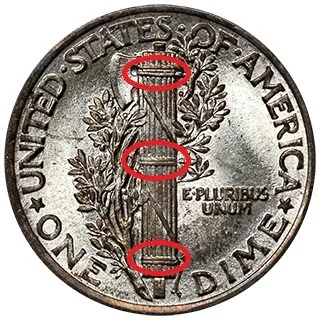
The center bands matter most. Both PCGS and NGC require them to be fully split, with a clear recessed line running all the way across. NGC also says the top and bottom bands must show separation. Any break in the split counts against it, including a nick, a scratch, or a bag mark sitting across the line.
Why Some Dates Are Rare With Full Bands
How often a date comes with Full Bands depends on where and when it was struck. In a 2018 article, NGC compared two dates it had graded in similar numbers: more than a third of its 1945-D dimes earned Full Bands, but fewer than 30 of its 1945 Philadelphia dimes did. That’s why a 1945 with Full Bands is one of the most famous strike rarities in U.S. coins, even though a plain 1945 is a common date.
Many of the early branch mint coins (Denver and San Francisco) are also hard to find with Full Bands.
Full Torch on Roosevelt Dimes (1946 to Date)
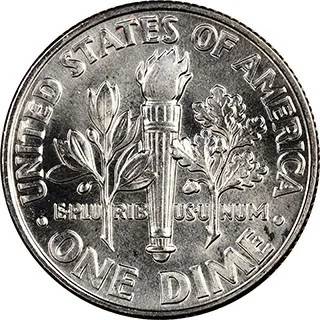
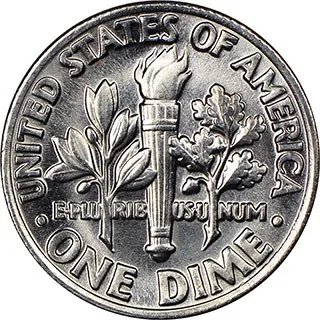
The Roosevelt dime has a torch on the back, wrapped by bands near the top and bottom. To get NGC’s Full Torch designation, both sets of bands must be fully separated, and the vertical lines on the torch must be clear and defined. PCGS uses an FT designation too.
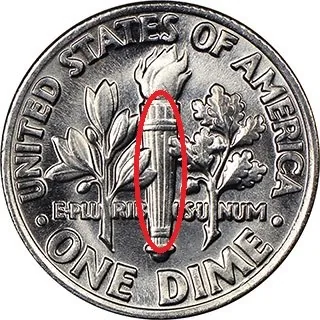
Full Torch applies to both the silver dimes (1946 to 1964) and the modern clad ones. Most Roosevelt dimes in circulation today were never sharp enough to qualify, so a Full Torch coin in a high grade can be worth far more than its face value or silver content.
Does a Coin Have to Be Uncirculated?
Mostly, yes. Wear flattens the bands quickly, so nearly every FB and FT coin is uncirculated. NGC says a dime doesn’t have to be Mint State to qualify. PCGS generally gives Full Bands only to Mercury dimes grading MS 60 or better, with exceptions for the rare 1916-D and the 1942/1 and 1942/1-D overdates, which can get FB as low as AU 50.
Proof dimes don’t get these designations. Proofs are struck more than once on special presses, so a full strike is expected.
FB and FT Can Be Combined With PL and DPL
NGC can add a Prooflike (PL) or Deep Prooflike (DPL) note too, for coins with mirror-like fields. On an NGC holder you might see:
- FB, FB PL, or FB DPL (Mercury dimes)
- FT, FT PL, or FT DPL (Roosevelt dimes)
NGC lists each of these on its own line in its census (the count of coins it has graded), so you can see how rare a date is with a full strike. NGC adds these designations as part of normal grading, at no extra charge.
Watch Out for Faked Full Bands
Because Full Bands adds value, some people try to fake it. The usual trick is to take a sharp blade and cut a line across the center bands to make them look split. To most buyers it can pass at a glance. To an experienced grader it’s easy to spot, because a tooled line looks different from a struck one.
That’s why it pays to buy expensive FB and FT coins only in a PCGS or NGC holder. Raw (ungraded) dimes sold as “Full Bands” should be treated with caution. See should I get my coins graded? for more on when grading is worth it.
How to Check Your Own Dimes
- Use a 5x to 10x magnifier and a single light, like a desk lamp.
- Tilt the coin slowly under the light. A true split catches a shadow all the way across.
- On a Mercury dime, look at the center bands first, then the top and bottom.
- On a Roosevelt dime, look at the bands near the top and bottom of the torch, and at the vertical lines between them.
- If the line fades out partway, or a mark crosses it, it won’t qualify.
Never clean a dime to get a better look. Cleaning lowers the value and can’t be undone. See should I clean my coins?
The Bottom Line
Full Bands (FB) on Mercury dimes and Full Torch (FT) on Roosevelt dimes mean the coin has a sharp, full strike in one key spot on the back. Most dimes don’t have it, and on some dates it can be worth much more than the date alone. If you have bright, uncirculated dimes, it’s worth a close look at those bands, and an expert opinion before you sell.
Have uncirculated Mercury or Roosevelt dimes? JoCo Coin Shop offers honest, no-obligation appraisals across the Kansas City area. Contact me by phone, text, or email to get started.