Roosevelt Dimes Worth Money: Silver Dates and Rare Varieties
Roosevelt dimes were made by the billions. The 1946 to 1964 ones are 90% silver; here are the few later dimes worth more than face value.
The Roosevelt dime has been made since 1946, and the Mint has struck billions of them. That’s the most important thing to know about this series: it was mass produced, and almost every Roosevelt dime is common. The silver ones are worth their silver, and only a few exceptions are worth more than that.
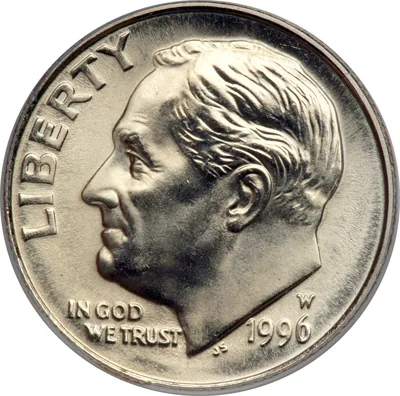
The Basics
- First released in 1946, shortly after President Franklin D. Roosevelt’s death. Roosevelt had founded the organization that became the March of Dimes, which made the dime a fitting tribute.
- Designed by John R. Sinnock. His initials, JS, are below Roosevelt’s neck.
- 1946 to 1964: 90% silver, about 0.07 troy ounces each
- 1965 on: copper-nickel clad, no silver (except special silver proof dimes)
A popular myth claims “JS” stood for Joseph Stalin. It didn’t; they’re simply the designer’s initials.
Silver Roosevelt Dimes
Any Roosevelt dime dated 1964 or earlier is silver. Check the edge: no copper stripe means silver. Even the lowest-mintage silver years were made by the millions, so silver Roosevelt dimes trade for their silver content no matter the date. See my junk silver guide.
Clad Dimes: Condition Is Everything
Since 1965, the Mint has made billions more, with some years topping two billion dimes. A clad Roosevelt dime from your change is worth ten cents.
The clad dimes you see selling for big money online are top pop graded coins: dimes graded as high as any other of that date, usually with Full Bands. A dime one grade lower can be worth little more than face value, and there’s no way to know whether a dime is top pop without having it graded. See what does top pop mean?
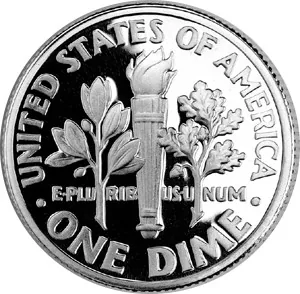
Full Bands (Full Torch)
On the back, the torch is wrapped by bands near the top and bottom. On a sharply struck dime, both sets of bands are fully separated and the lines on the torch are crisp. PCGS calls this Full Bands (FB), and NGC calls it Full Torch (FT). It only matters on uncirculated dimes in top grades. See Full Bands and Full Torch dimes for what to look for.
The Few Exceptions
- 1982 “No P”: In 1982, some Philadelphia dimes were struck without the P mint mark. These are worth a solid premium.
- 1996-W: Made at West Point for the dime’s 50th anniversary and only included in that year’s mint sets, so it never circulated (officially).
- Proof dimes missing the S: A few proof sets from 1968, 1970, 1975, and 1983 have a dime with no S mint mark. They’re rare, and the 1975 is one of the rarest modern U.S. coins.
Errors to Watch For
Like any coin, Roosevelt dimes can have genuine errors: off-center strikes, clipped planchets, and dimes struck on the wrong blank. See error coins to look for in your change.
More guides: what does top pop mean?, Full Bands and Full Torch dimes, Mercury dimes, Barber coins.
The Bottom Line
Roosevelt dimes were mass produced, so date alone almost never makes one valuable. Dimes dated 1964 or earlier are worth their silver. Later dimes are worth face value unless they’re one of the few exceptions above or a top pop graded coin.
Have silver coins to sell? JoCo Coin Shop offers honest, no-obligation appraisals across the Kansas City area. Contact me by phone, text, or email to get started.