Silver War Nickels: Which 1942–1945 Nickels Are 35% Silver?
Did you know nickels made during WWII contain real silver? Learn how to spot 1942–1945 35% silver 'War Nickels' by their giant mint mark.
Almost everyone who sorts through old change knows the 1964 rule: dimes, quarters, and half dollars dated 1964 and earlier are made of 90% silver.
Because of that rule, most people assume that U.S. five-cent pieces—called “nickels” for a reason—have always been made of a base copper-nickel blend worth five cents.
However, for a brief window during the height of World War II, the U.S. Mint completely removed nickel from the five-cent coin and replaced it with 35% pure silver. Known to collectors and bullion dealers as “War Nickels,” these coins still turn up regularly in inherited coin jars and old nickel folders, and one simple visual clue makes them easy to spot.
Why Did the U.S. Mint Put Silver in a Nickel?
From its introduction in 1866 right up to today, a standard U.S. five-cent piece has been struck from an alloy of 75% copper and 25% nickel weighing 5.00 grams.
When the United States entered World War II after Pearl Harbor, nickel immediately became a critical strategic war material. The military needed every available pound of nickel to harden steel armor plating for tanks, battleships, and aircraft engines.
In March 1942, Congress authorized the Mint to use a substitute alloy for the five-cent coin that wouldn’t jam existing vending machines, payphones, and subway turnstiles. By October 1942, Mint metallurgists settled on a unique wartime formula:
- 56% Copper
- 35% Silver
- 9% Manganese
This wartime alloy was used for part of 1942 and for every single nickel struck in 1943, 1944, and 1945. Once the war ended, the Mint returned to the standard copper-nickel composition in 1946.
The Giant Mint Mark: How to Spot a Silver War Nickel Instantly
Because 1942 was a transition year—meaning the Mint struck millions of normal copper-nickel 1942 nickels earlier in the year before switching to the silver formula in the fall—government officials needed a bold, unmistakable visual marker so the silver nickels could be easily identified and pulled out of circulation after the war.
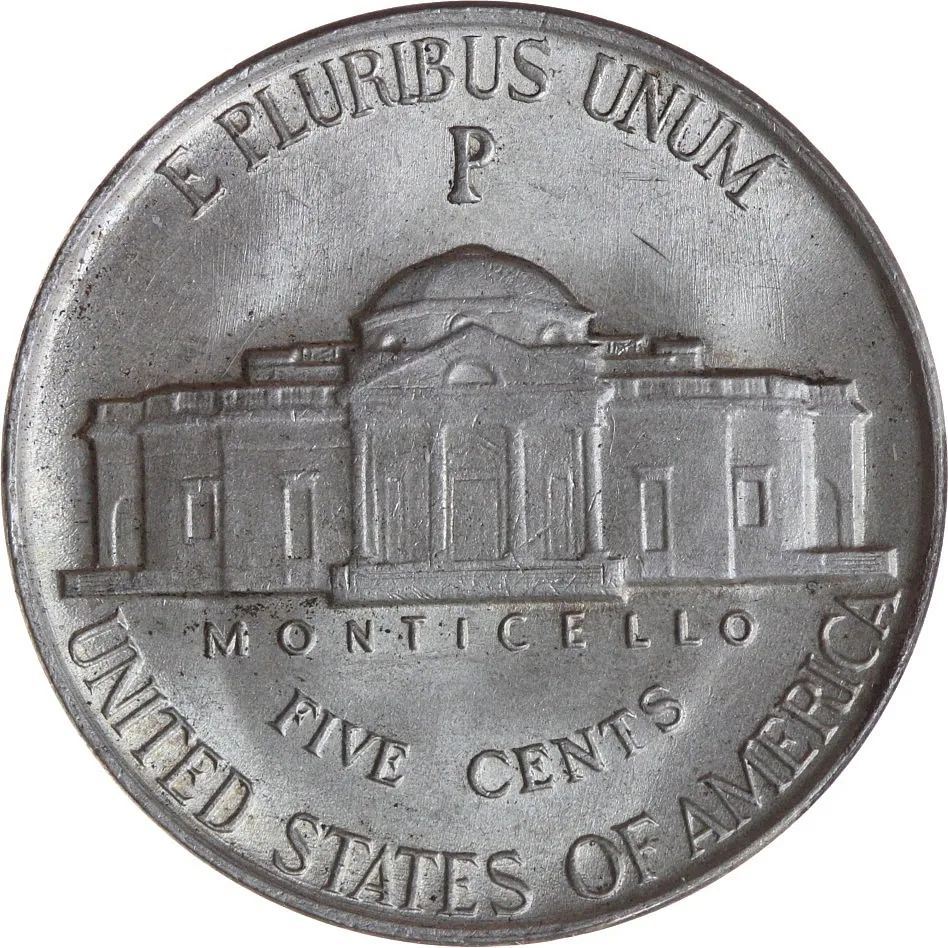
Their solution changed U.S. coinage history: they placed a massive mint mark directly above the dome of Monticello on the back of the coin.
Here is how to check any Jefferson nickel dated 1942, 1943, 1944, or 1945:
- Flip the coin over to view the Monticello building on the reverse.
- Look in the open sky directly above the center dome of Monticello, just beneath the words E PLURIBUS UNUM.
- If you see a large, bold P, D, or S floating above the roof of Monticello, it is a 35% silver War Nickel.
- If the space above the dome is blank (and on a 1942 coin, the tiny mint mark is tucked beside the right side of the building or missing altogether), it is a normal copper-nickel coin with zero silver content.
Fun Numismatic Fact: The 1942-P through 1945-P silver War Nickels marked the very first time in U.S. history that the Philadelphia Mint placed a “P” mint mark on a circulating U.S. coin!
Why Do War Nickels Look Dark Greenish-Gray?
Even across a table, experienced dealers can usually spot a silver War Nickel in a pile of change before turning it over to check the mint mark.
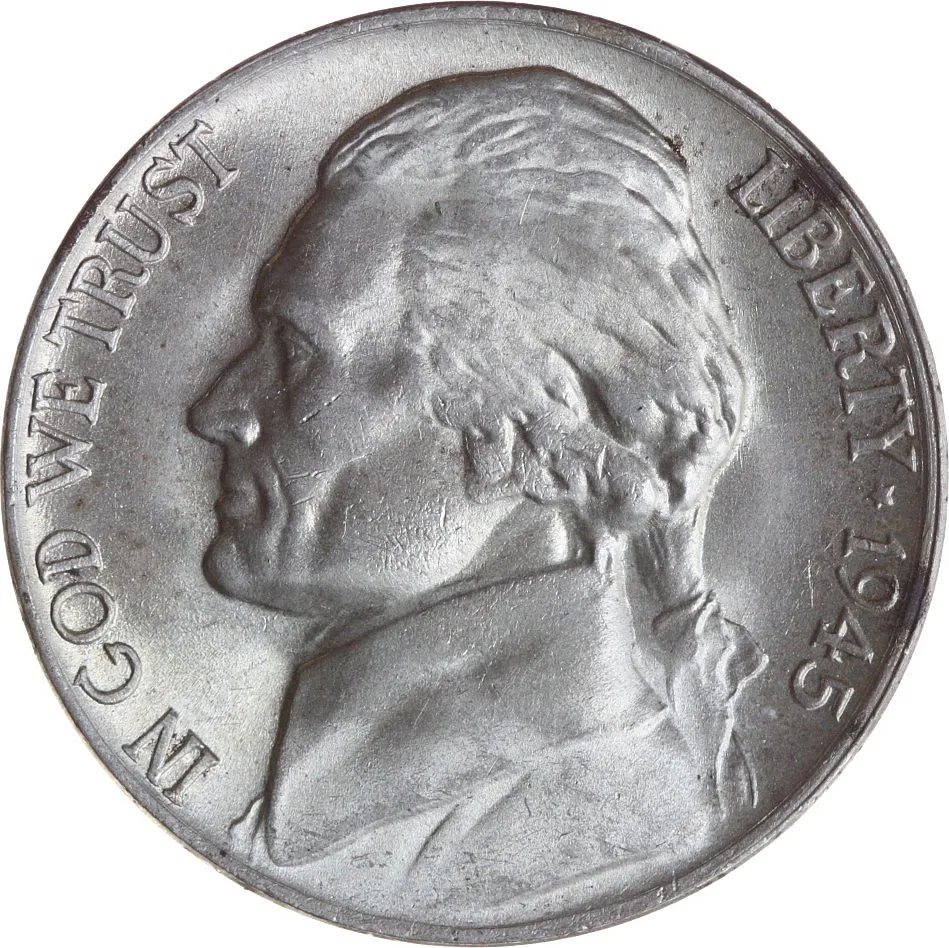
Because of the 9% manganese blended with the silver and copper, War Nickels oxidize differently than both normal nickels and 90% silver dimes. Over decades of circulation, they develop a distinct charcoal-gray, pewter, or slightly olive-greenish patina that looks noticeably darker and softer than a shiny modern nickel.
How Much Silver Is Inside a War Nickel?
Every 1942–1945 silver War Nickel weighs 5.00 grams, and 35% of that weight is pure silver. When you run the math in troy ounces:
- 1 War Nickel contains 0.05626 troy ounces of pure silver.
- A standard 40-coin roll ($2.00 face value) of War Nickels contains 2.25 troy ounces of pure silver.
- Roughly 18 War Nickels add up to 1 full troy ounce of pure silver.
In addition to their silver melt value, certain War Nickel varieties—such as the famous 1943/2-P Overdate (where a “3” was punched over a “2” in the date) and the 1943-P “Doubled Eye” variety (with clear doubling around Jefferson’s eye)—carry healthy numismatic collector premiums when found in sharp condition.
The bottom line
Next time you are going through an old jar of coins or an inherited Jefferson nickel album, don’t skip the nickels. Check every 1942, 1943, 1944, and 1945 nickel for that oversized P, D, or S above Monticello’s dome—each one holds more than a twentieth of an ounce of historic World War II silver.
Have a coin like this? JoCo Coin Shop offers honest, no-obligation appraisals across the Kansas City area. Contact us by phone, text, or email to get started.