Confederate Money: Is It Real or a Reproduction?
Most Confederate money found today is a souvenir reproduction. Here's how to spot copies, what genuine notes look like, and what real ones are worth.
Confederate money turns up surprisingly often in family papers, old books, and estate boxes. Some of it is genuine Civil War currency. But a large share is reproductions: souvenir copies sold for decades at gift shops, museums, and tourist sites. Here’s how to tell the difference.
A Little History
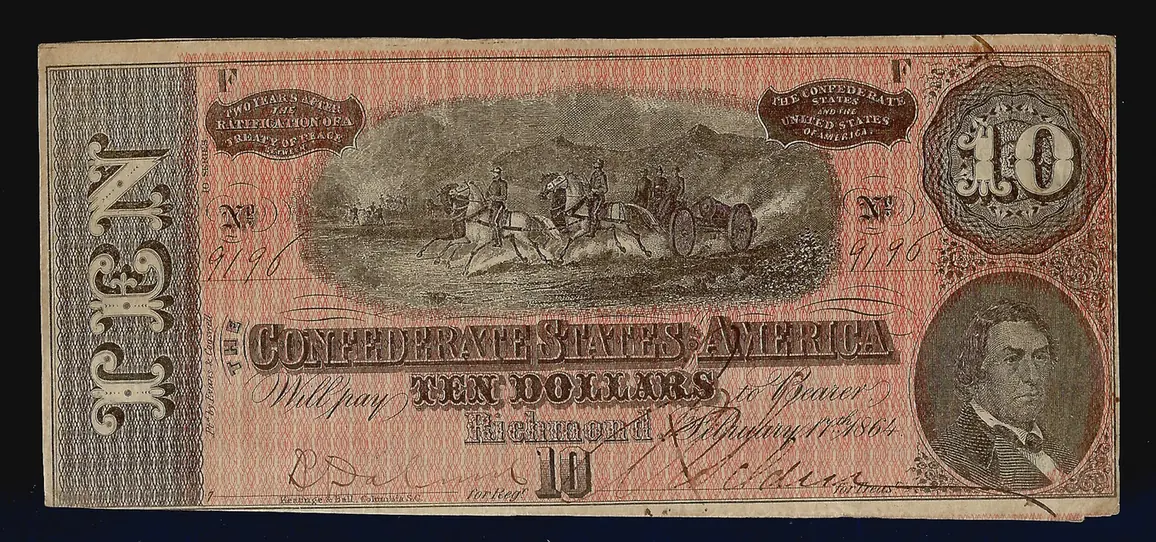
The Confederate States of America issued paper money from 1861 to 1864. As the war went on, the Confederacy printed more and more notes, and their value collapsed. By the end of the war they were nearly worthless, and many survived simply because people kept them as keepsakes.
The 1864 notes were printed in the largest numbers and are the most common today.
Signs of a Reproduction
- Brown, “aged,” or parchment-like paper. Many souvenir copies are printed on stiff, tan paper made to look old. Genuine notes were printed on thin paper that varies in color, but usually isn’t uniformly brown.
- The word COPY or FACSIMILE printed on the note, often small, on the back or in a margin.
- Identical serial numbers on several notes. Reproduction sets often use the same number.
- Printed signatures. On most genuine Confederate notes, the signatures were written by hand in ink by clerks. On copies, they’re printed.
- Blank backs on notes that should have a design, or backs printed with advertising.
- Perfect, flat condition with no signs of folding or handling, on paper that looks artificially aged.
Signs It May Be Genuine
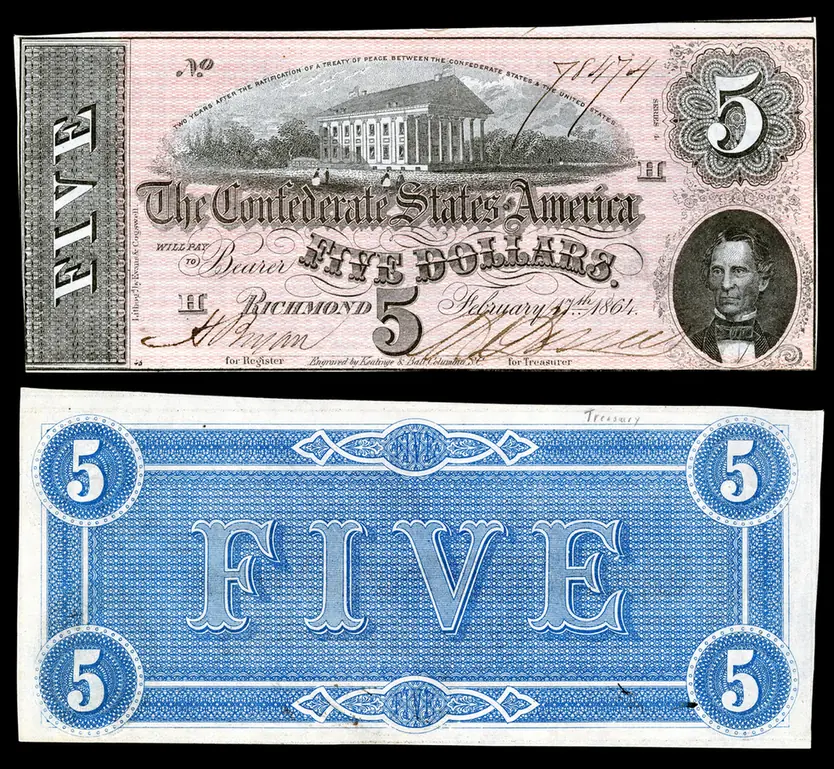
- Hand-signed signatures in ink, often slightly faded or brownish
- Thin paper with genuine wear, folds, and soft edges
- Fine engraving with sharp detail in the portraits and borders
- Serial numbers written or printed individually
What Genuine Notes Are Worth
Genuine Confederate notes, especially common 1864 issues, are affordable collectibles. Value depends on the type, condition, and rarity. Early issues from 1861, especially those printed in Montgomery, Alabama, are rare and valuable. Notes in crisp condition bring more than worn ones.
Some counterfeits made during the Civil War itself are also collected as historical pieces. They’re a specialty of their own.
What Reproductions Are Worth
Souvenir reproductions have no collector value. They’re fun keepsakes, but they aren’t currency and aren’t collectible. U.S. law requires modern reproductions of currency and coins to be marked as copies.
More guides: fractional currency, silver certificates, National Bank Notes.
The Bottom Line
If your Confederate note is on brown, parchment-like paper with printed signatures, it’s almost certainly a souvenir copy. Genuine notes have hand-signed signatures, thin paper, and fine engraving. I don’t buy reproductions, but I’m happy to tell you honestly which you have.
Have Confederate or other old paper money? JoCo Coin Shop offers honest, no-obligation appraisals across the Kansas City area. Contact me by phone, text, or email to get started.